The idea that light has some sort of speed at which it shiningly travels may very well be flawed.
Could it be that time and space hasten into reality at just the right speed with just the right quantized steps as energy turns into all sorts of quantized manifestations...?
Friday, March 17, 2006

Tuesday, March 14, 2006
Last night as I was sleeping
~ Antonio Machado
Translation: Robert Bly
Last night as I was sleeping,
I dreamt-marvelous error!-
that a spring was breaking
out in my heart.
I said: Along which secret aqueduct,
Oh water, are you coming to me,
water of a new life
that I have never drunk?
Last night as I was sleeping,
I dreamt-marvelous error!-
that I had a beehive
here inside my heart.
And the golden bees
were making white combs
and sweet honey
from my old failures.
Last night as I was sleeping,
I dreamt-marvelous error!-
that a fiery sun was giving
light inside my heart.
It was fiery because I felt
warmth as from a hearth,
and sun because it gave light
and brought tears to my eyes.
Last night as I slept,
I dreamt-marvelous error!-
that it was God I had
here inside my heart.
~~~~
It's so wonderful that the original meaning of the word 'error' is used here... which in the beginning of its use never meant 'mistake' but... walking in a wandering manner!
"Caminante, no hay camino
Se hace camino al andar."
(Walker, there is no path.
The path is made by walking.)
"Caminante, son tus huellas el camino, y nada más; caminante, no hay camino, se hace camino al andar. Al andar se hace camino, y al volver la vista atrás se ve la senda que nunca se ha de volver a pisar. Caminante, no hay camino, sino estelas en la mar."
~ Antonio Machado
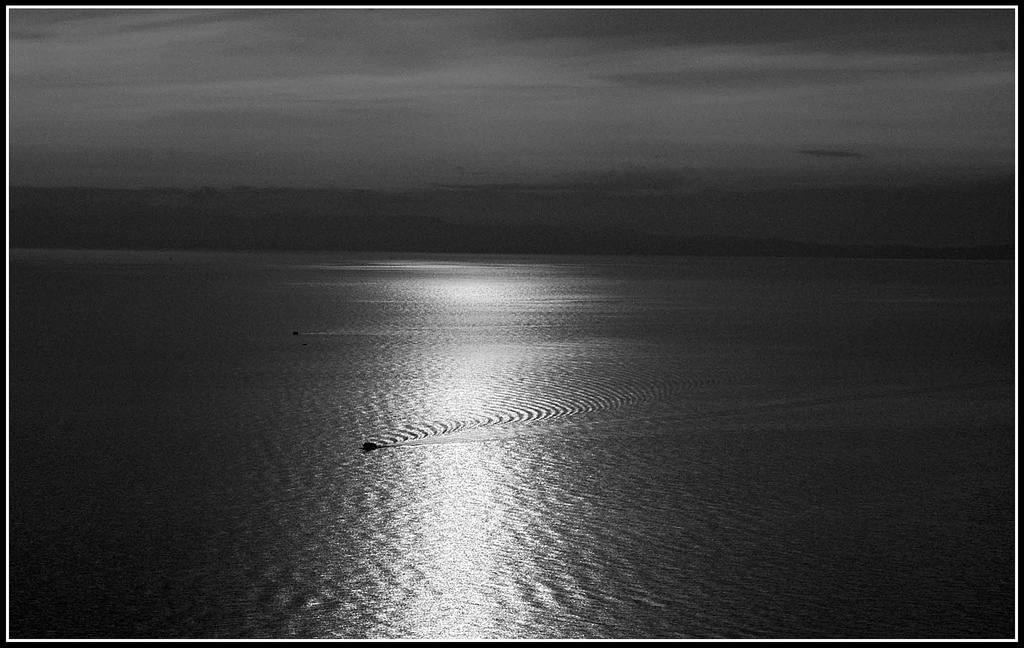
Estelas en la mar
(Wanderer, your footsteps are the road, and nothing more; wanderer, there is no road, the road is made by walking. By walking one makes the road, and upon glancing behind one sees the path that never will be trod again. Wanderer, there is no road - only wakes upon the sea.)
"The path is made by walking".... yes!
Which insight together with "a fiery sun was giving light inside my heart" leads to "God I had here inside my heart"... divine nature realizing itself into divine light as space/time is formed and matter manifests the universe's divine nature.
Thus, 'all-that-is' in all its nuances, from the densest to the lightest, processes (as in procession) from the core of all that is...
Which brings up the following:
Could it be that the idea that light has some sort of speed at which it shiningly travels is flawed?
Could it be that time and space hasten into reality at just the right speed with just the right quantized steps as energy turns into all sorts of quantized manifestations...?
Wednesday, January 11, 2006
Mirror Neurons
Before reading the following, please click the above link
and this one
A Discussion on a New York Times article
and this one
A Discussion on a New York Times article
The implications of the notion of mirror neurons for psychology are enormous, in light of this the regular understanding of psychological concepts such as bonding, projection, learning, transference, empathy/apathy/sympathy, obsession, compulsion, being 'anal' - all that and more - needs to be reviewed.
Now that we may have some physio-biological understanding behind the process of possible automatic absorption of what children 'see' and how they subsequently 'may' feel prompted to act out what they are watching as they are duplicating and replicating what they are watching, this understanding may even form some basis for discussing serious guidelines or policies - even formal legislation - to limit access to violent depictions in the media of plays, games or TV shows aimed at young children,
The following TED presentation by VS Ramachandran may point at when the human mind came into play after the brain was already formed (Lamarckian evolution - mutation).
There are about 5 different but related themes touched upon in this fast 7 minute talk from: 'learning by mirroring' to 'phantom limbs', via 'oneness and separation'... and perhaps the notion how the mind is totally and integrally connected to physiology... Skin receptors make the difference!
"The neurons that shaped civilization about 100.000 years ago."
Click TED Presentation by VS Ramachandran
Some questions around this
- Is it necessarily so that children 'w i l l' act out those mirrored observations?
- There is the expression 'monkey see, monkey do', but with humans, can that as easily be translated into 'child see, child do' or in a broader sense 'human see, human do', or is it for humans perhaps 'human see, human may or may not do'?
- Is there is a 'control of error' mechanism built into or around this mirror neuronic infrastructure? Or - if there is no such thing built in - is it that, why we have the conventional and more or less tested moral codes acting as a set of checks and balances?
I myself believe that there is something structurally built-in around mirror nearons that acts as a 'control of error' (I'm thinking along the lines of Montessorians, to which 'control of error' comes naturally without saying), something of which more conventional moral codes may be watered down copies that have been reprogrammed to attain ulterior goals that do not necessarily benefit the individual itself but something or someone else that is made to feel more important or greater than the individual (kind of like the 'Nazi ideal', cultic zealot, or the 'suicide hero') - Are we ready for a possible paradigm shift in education and culture cultivating...?
- Even some popular notions developed by Piaget, some of his conclusions may also have to be thoroughly reviewed. (Some of which even became urban myths... and urban myths are so resilient... Maybe there are specialized mirror neurons that turn modeling based on flawed thinking - when it is brought forward 'cleverly and craftily' - into urban-mythical post-conceptions or maybe even cultural pre-conceptions.)
- Can we implant new mirror neurons? Should we?
- Can we replace those neurons that replicated/duplicated less savory or less acceptable impressions and thus produced less beneficial social behavior? Should we?
- Can we fix the broken neurons? Should we?
- Can we now also find out what actually causes autism, obsessive compulsive disorders and even... sociopathic or psychopathic behavior?
- How do we influence each other's moods, can we protect ourselves from being influenced
- 'Spells', 'mesmerizing', 'black magic' - does this makes use of mirror neuron dynamics?
A consideration - are certain kinds of mirror neurons only 'proposal' neurons?
There is an issue not touched upon in depth yet when it comes to mirror neurons: is there not a certain 'proposal' or 'proto type' quality to what mirror neurons duplicate/replicate?
There could of course be different types of mirror neurons, some more absolute in their power to duplicate and force replication, and some only having a function to offer optional action, proposing action, a model that could be copied and duplicated?
So far, the way I see it, in humans there seems to be a choice somewhere in the individual:
- to take the impressions seriously and follow up on them as though they were one's own
- or to hold them in abeyance for the time being and not choosing - after certain considerations - to act them out in perpetuity and 'thoughtlessly'?
- Is that where consciousness comes in and following from that, conscience or moral considerations?
- And IF there is an 'observer' to all this, a 'witness', how is that witness/observer present, does the possible presence of the witness fade or return after fading?What is it, if so, what makes that occur?
- How do we forget?
- If we believe that they can be stopped, how do say 'compulsive actions' or addictions stop, as a result therapy, meditation or whatever we do to become less driven by or attached to our them?
- What have we done with those mirror neurons when we deactivated, say, addiction (if we did :) if those mirror neurons were involved in creating obsessive compulsive behavior?!
An answer already?
For me one answer is showing up already, let me try it.
It has to do with identification, which by itself is GOOD as there is in principle nothing wrong with identification!!! However, when individual identification gets adulterated (from the Latin ad-alterare) with 'alien' identities that are pressed upon it by fear and social pressure, the original identification gets tainted or enveloped by the additional exterior descriptive packaging and then turns into adverse non authentic behavior... the pseudo self or the usual state of conflict that someone is in, someone who is not 'feeling him or herself' - who lost touch with their core and does not live directly from it. The tainting or enveloping is brought about by verbal sentencing or ambiguous labeling.
- When we say "pig" to a little piggy that we may be holding on our lap, then the word "pig" is not a lie, it is a NOUN, and 'as that' it is simply a sound that symbolically labels the oinking thing on our lap. "Pig" means nothing more or nothing less than that what it symbolizes. In principle there are no secondary meanings to nouns applied this way... they are 'eigen' labels (German 'eigentlich').
(Is it that is what the biblical Adam did, so to speak? Was he simply tagging when he was naming?)
Identification with labels that way IS NOT detrimental, these labels it don't describe, they are sound stamp'. - However... When we have a child on our lap, and we label it with an ADJECTIVE (one part of a set of dualistic opposites. e.g. good or bad, or dirty or clean) AND/OR a NOUN which the child may have heard (or will hear) also applied as a label to another thing say "PIG" or "PAL" or "SQUIRT" then a self identity conflict is created, as the child will now identify with ambiguity... eventually, especially after a few repeats, leading to not feeling him or herself, the identities are confused and confusable.
Identifications with such labels ARE detrimental... they describe and alter (the meaning of 'adulterate'), they might lead to judgments away from the simple statements, they are not 'sound stamps', they are something that possibly mark the child as that what it is not: 'Being-who-one-is-that-one-is' is then challenged and traumatized. How to undo that... how to undo that pseudo ambiguous self (German 'uneigentlich sein')? Sitting simply and congruently in oneself (maybe return to the lap and getting simply and unambiguously relabeled, de-identified and re-identified) 'unsaying-oneself', unsaying the conflicted/conflicting identity meanings!!!Maybe the thing to do then is... applying silence that may help the un-wording, erase ambiguous labeling... the echo fading and disappearing.
Echo Neurons and Mirror Neurons?
I anticipated something like mirror neurons but called them 'echo cells' as I was at some point more interested in the onomatopoeic phenomenon in human speech.
Renaming the 'mirror neuron' to 'mirror/echo neurons' maybe be an idea worth considering as it might open a wider vista allowing us to find clearer answers sooner, or, if not that, than at least better questions may arise that may lead to better answers. So, if we, instead of just using the word, "MIRROR" neuron, we use the word "MIRROR/ECHO" neuron, we might pick up on a different model for understanding this neuronal duplication phenomenon and come up with questions like:
- Is there a 'fade' effect? (As in the theory of sound: 'attack', 'sustain', 'decay'.
- Are there built in volume, loudness or intensity controls?
- Do initial 'impressions' - when they are verbal or auditory they are called 'engrams' - need to be re-struck like we can strike a bell again, to stay active?
Obviously two senses are involved visual (mirror) and auditory (echo). They are distinct from other senses (http://en.wikipedia.org/wiki/Sense) in that they are remote sensing... as no physical contact is involved (no tactile, gustatory, olfactory contact. Smelling involves molecular contact within the nose, so I don't consider the olfactory sense a remote sensing tool per se.)
(For the 'mirror neuron' discussion in it scroll down to page 6 and look for "Mirror, Mirror")
Comments on this article (all underlining is mine):
"Rizzolatti's group recently reported that the macaque has "audiovisual" mirror neurons: Some of the cells in F5 fire not only when a macaque watches a meaningful grasping action, but when it hears the sound of one, such as the sound of breaking peanuts."
Notice the word grasping above, in my 'brain/mind theory I consider 'mind' (Skt. 'manas') to be derived from the PIE root *man (cf. 'la main' Fr. - hand) being involved in mental development...
Thus my 'brain/mind and hand go hand-in-hand'
My brain/mind theory includes a rather axiomatic:
- There is no mental activity without a thought,
- There is no thought without verbal content,
- There is no verbal content without sensorial recording,
- There is no sensorial recoding without matter...
Thus for humans 'matter, hand and mind go hand-in-hand'
Except for "Ouch" :), the earliest and simplest words derived from onomatopoeic sound-mimicry by means of what are now called mirror neurons... which I at some point identified as 'echo cells'.
"...mirror neurons are found in brain areas responsible for grasping. "I think it's extremely likely that language evolved in our early ancestors as a manual system , not as a vocal one" "
~ Corballis."
But partially overlapping that manual system, a verbal/mental one developed over time, using:
'words-verbalized-aloud-or-muted-as-thoughts'
"But others believe equally strongly that even if movement and language are inseparable, language is primarily an oral, not manual , behavior. Psychologist Peter MacNeilage of the University of Texas, Austin, has developed a theory that monkey oral behaviors (not vocalizations) are precursors of human syllables, and he argues that the mirror neuron system--especially the recent discovery of neurons that respond to lip smacking and nut cracking--bolsters his ideas."
Primarily an oral, not manual, behavior should of course read "primarily an oral, not primarily a manual behavior".
The oral aspect is not at the exclusion of the manual aspect!
The syllables idea is almost right, instead of syllables though, abugida type of languages (such as Sanskrit) use consonant–vowel units (when written they consist of consonant-vowel notations). These units tend to be onomatopoeic.
The fact that the early human adopted a partial nocturnal (eve and dawn) living style (night falls at 6PM and day breaks at 6 AM in tropical regions - it only takes five minutes for the falling and breaking!) caused the visible gestures to have to be replaced by audible voices.
Communicative gesture HAD to be replaced by communicative sound.
Saturday, November 26, 2005
Skepticism, interpretation and investigation
Pete (an avowed skeptic): To be a skeptic we must first renounce all reliance on authority. From early childhood we were conditioned to accept the authority of our parents. We knew nothing; they knew all we needed to know. It was a good thing that we accepted their guidance. It was a good thing we trusted our teachers, as well. But this created a feeling that others know best. An attitude of dependency and gullibility, most never outgrow, and so they trust their government officials, their preachers, the media, and their friends to tell them how to live.Ok, maybe, we here, are past that stage, but still authority is there ensconced in our minds as ideas we never question. It's the habit of questioning all your thoughts, of accepting nothing at first sight that creates that sixth sense which rings a bell, and alert us to look again. After all, when at the fruit market we don't grab just the fruit which lies on top of the pile and put it in our bag. No, we look it up and down, we turned it around, we give it a squeeze. If we took as much care with ideas, that sixth sense would be there to lead us where ideas are no longer fences, but just temporary wings.
Randy: Cynicism is distracting and skepticism should never be practiced towards one's own direct experience.
Pete: Correct! Only toward interpretations of such experiences. But.... whatever you, or anyone else, thinks, speaks or writes is an interpretation.
Wim: That may very well be, but whatever someone originally conveys of an experience is in the first instance a description of what the sensorial faculties report to the experiencer. Such a description is not necessarily an interpretation right off the bat.
It is more often the listener who interprets the speaker's experience when the listener attempts to make sense of the speaker's conveyed experience, especially when the description of that experience does not exactly translate into something the listener can relate to or has experienced him/herself.
However, what is conveyed originally can also quickly become an interpretation by the original speaker, especially when he/she feels not being understood or feels that what is conveyed is not being validated... This may now cause the speaker to augment his/her experience with interpretive descriptions to win over the misunderstanding, skeptical or disapproving listener.
It may be interesting to find out how the word 'interpretation' is to be interpreted. :)))
The word 'interpretation' derives from the Latin 'inter' (amongst, between) and 'prattein' (Greek for speaking, ME prate, DU praten, E prattle).
Interpretation originally had to do with language translation. Later it received the meaning of conveying a particular version or explanation of a notion, act or piece of work. The meaning of a teaching method also developed, e.g. an interpretive nature program.
Over time 'an interpretation' also came to mean 'someone's take or even slant on things'.
Initially inter-pretation was done by 'agents' who conveyed messages between between peoples of a different tongue. 'Inter-prete' originally meant to convey translated messages.
When such a translation is done well, there is of course nothing left to 'interpretation'... the 'slant' meaning :))
But back to Pete's remarks on skepticism.
I don't think that one has to be cynical or skeptical in one's attempts to truthfully understand any issue. Cynicism and skepticism often merely reflects how cynics or skeptics themselves were treated by their peers...
The cynic or skeptic may just be passing along a certain mode of mildly derisive behavior that has nothing much to do with inspection, investigation and inquiry to... reach clarity.
Randy: Cynicism is distracting and skepticism should never be practiced towards one's own direct experience.
Pete: Correct! Only toward interpretations of such experiences. But.... whatever you, or anyone else, thinks, speaks or writes is an interpretation.
Wim: That may very well be, but whatever someone originally conveys of an experience is in the first instance a description of what the sensorial faculties report to the experiencer. Such a description is not necessarily an interpretation right off the bat.
It is more often the listener who interprets the speaker's experience when the listener attempts to make sense of the speaker's conveyed experience, especially when the description of that experience does not exactly translate into something the listener can relate to or has experienced him/herself.
However, what is conveyed originally can also quickly become an interpretation by the original speaker, especially when he/she feels not being understood or feels that what is conveyed is not being validated... This may now cause the speaker to augment his/her experience with interpretive descriptions to win over the misunderstanding, skeptical or disapproving listener.
It may be interesting to find out how the word 'interpretation' is to be interpreted. :)))
The word 'interpretation' derives from the Latin 'inter' (amongst, between) and 'prattein' (Greek for speaking, ME prate, DU praten, E prattle).
Interpretation originally had to do with language translation. Later it received the meaning of conveying a particular version or explanation of a notion, act or piece of work. The meaning of a teaching method also developed, e.g. an interpretive nature program.
Over time 'an interpretation' also came to mean 'someone's take or even slant on things'.
Initially inter-pretation was done by 'agents' who conveyed messages between between peoples of a different tongue. 'Inter-prete' originally meant to convey translated messages.
When such a translation is done well, there is of course nothing left to 'interpretation'... the 'slant' meaning :))
But back to Pete's remarks on skepticism.
I don't think that one has to be cynical or skeptical in one's attempts to truthfully understand any issue. Cynicism and skepticism often merely reflects how cynics or skeptics themselves were treated by their peers...
The cynic or skeptic may just be passing along a certain mode of mildly derisive behavior that has nothing much to do with inspection, investigation and inquiry to... reach clarity.
Friday, November 18, 2005
Reality does not require belief
If you want to know what is real, just let go of ALL beliefs.

"Reality manifests when you let go of all beliefs."
~ Written on a wall in Omaha, 2003.
Wednesday, November 16, 2005
Tuesday, November 15, 2005
One & All
Arvind: Like so many people I wonder many times about singularity and multiplicity of Self!
Wim: You mean "singularity" as in "One and all" - singularity being "One"?
And do you mean "multiplicity" as in "All is One" and "We are all one" - multiplicity being "all" or everything?
Arvind: Yes, something like that...
Wim: And as for your use of the word "Self" when you said, "singularity and multiplicity of Self", do you mean something like the higher or deeper Self is the singularity - say, the divine One - and the smaller selves are the multiple forms of multiplicity?
Arvind: Yeah, what I mean is that there is one God and that everything and everyone is a representation of God in individual smaller formats and... but... hmm... that all those individual representations might not really be real, that only "The One" is real, that only the divine higher SELF is real and that the small selves are just egos or something... that we have to reach beyond our small selves to really meet our "one and only" reality!
That's what I wonder about a lot, "What is real, what is what really?
I feel being thrown back and forth between those two distinctions... All or one.
Wim: Hmm... I think that the neat thing is that we don't have to make a choice between say, the big SELF or the little self, the ONE or the many, singularity and multiplicity.
Don't you think that it could simply be simultaneous and coincidental... that there is no qualitative distinction between the two, and also that the ONE is not before the All, a cause/effect kind of thing?!
I seem to sense that you feel there is some qualitative distinction and that if you choose wrongly that you will feel caught or that you will loose out.
Arvind: Yes, it feels that way...
Wim: Those dichotomies and dualities eh?!
Ah, the distinctions that we feel we somehow have to choose between!
Hmm...
But we actually don't have to choose, it is just that we... unfortunately and actually needlessly... that we have grown accustomed to 'having to make a choice' between:
- this or that,
- not this but that,
- this, but only after that,
- etc.
In quantum mechanics there is something known as the "collapse of the probability wave function" which results when the probability wave function gets squared'... Hmm. It is related to this.
Don't we sometimes say, "We have to square with time"? - square off with time really?!
In Quantum Mechanics with certain complex representations of these probability functions "upon collapse", time also gets squared and... that's the crux of the matter... time's linearity and sequentiality disappears... and it is that what allows for that coincidental simultaneity of what is usually seen as dichotomous, dual, linear and sequential.
"One is all" or "singularity AND multiplicity" can both be experienced at once. In fact, we already always experience singularity and multiplicity at once.
We already always do, except that:
- we tend to "live" according to a linear description of the world...
- we describe our experience of life as though we are living in a world that seems limited to only three dimensional space and one dimensional time, the "space time continuum"... while we NOW scientifically "know" that the world is at least eleven-dimensional. (In my experiential view even 12).
Anyway, one could say that we "live" according to a simplified description of the world... as though we have taken the root (root as in "square root") of "complex circumstantiality" so that we can wrap our customary causal and linear mind around it - so that we can simplistically talk about it in some linear fashion... follow me? (Pun intended.)
Come to think of it, similar to when we had to update our worldview when we found that the earth was not the center of the universe nor flat (the days of Copernicus, Columbus and Amerigo Vespuci) it is now again time to update our paradigms.
Timeline Copernicus Columbus
One of the first well known educators who attempted to do that with the 20th century's newest scientific findings (although most people who know her don't think about her that way) was Maria Montessori. From the year 1905 (when Einstein came with his relativity theory!!!) she created an educational system that took Einstein's' relativity and other scientific discoveries (e.g. De Vries - biology, Lorentz - mathematics) of her times into account. Too bad that many a Catholic nun who applied her system had no inkling of the reach of Montessori's vision and ideal. It is now (2005) 100 years since...
Arvind: OK, sure, hmm... let me think...
In any case, to get back to what I was saying, in my incarnated form I can't deny multiplicity.
Wim: Of course not! Good for you!
And why not celebrate that, enjoy it and rejoice in it?!
Why would even the thought to "deny multiplicity" have to come up?
Why would one feel one may have to deny this endless and wondrous variety that multiplicity has to offer?!
Arvind: But you know Wim, when I die... when I let 'I' die... I find no other and others.
Wim: But Arvind, "I" never dies... let me expl...
Arvind: There is no secondary reality but "I", "ME"...
Wim: Ah Arvind, let me just say it very clumsily, it's a good thing that "God" does not feel like having to make a choice between his "I" and "you", that he doesn't feel like making a choice and having to come up with: Just ME GOD, not you!
Good thing that God lets you and I be, that he lets multiplicity and singularity be.
Maybe that's why you and I can talk about this...
Arvind: But Wim, when I focus on the temporary forms, I perceive many, but when I dive within... I find no other, no others.
Wim: You may not "find" other or others, but have they really disappeared?!
But all right... if they seem to have disappeared, I'd suggest they only disappeared out of sight, not out of existence!
Arvind: But isn't it self-evident that I am not "you" or "the other"?!
Wim: That is "o n l y" seemingly self-evident, it appears so to the "lower case self" - atman, the one so used to feeling excluded from the "upper case SELF" - paratman.
So, such seeming evidence is by convention rather limiting and limited to "self" and "i" (lower cases) and is therefore seemingly not inclusive of say for example "me - the other" and "ME - the "ONE".
Wednesday, November 09, 2005


Subscribe to:
Posts (Atom)